

Article / Research Article
1Neonatology Service, Hospital General Dr. Jose Maria Rodriguez, State of Mexico.
2Human Milk Bank, Hospital General Dr. Jose Maria Rodriguez, State of Mexico.
Dr. Perla Karina García-May,
Dr. José María Rodríguez General Hospital, IMSS Bienestar, Mexico.
9 June 2026 ; 23 June 2026 ; 3 July 2026
Citation: Perla Karina García-May & Alvarado Zuñiga (2026). Calorie Content of Breast Milk: Response to a Weekly Strategy for Breastfeeding Mothers. G Women’s Health Car, 2026; 7(1):1-6. DOI : https://doi.org/10.47485/2766-5879.1024
Background: Human milk is the ideal source of nutrition for newborns. Creamatocrit is a simple, cost-effective, and reliable technique to estimate its caloric content, particularly useful in hospital human milk banks.
Objective: To evaluate the energy content of donated human milk using creamatocrit at the Human Milk Bank of Hospital General Dr. Jose Maria Rodriguez, and to assess the impact of an individualized nutritional counseling program on the caloric quality of milk from lactating mothers.
Methods: Observational, retrospective, analytical, cross-sectional study. A total of 200 donated frozen milk samples were analyzed from May to August 2024 (50 samples/month, random selection). Additionally, a longitudinal follow-up was conducted on 20 lactating mothers with four serial creamatocrit measurements before and after individualized nutritional counseling sessions.
Results: Caloric content of the milk bank ranged from 480 to 760 kcal/L, with a mean of 576 +/- 38.9 kcal/L, below the 670 kcal/L reference value for mature human milk. No correlation was found between gestational age and caloric content. In the counseling program, initial creamatocrit was 576.5 +/- 83.3 kcal/L, increasing to 827.4 +/- 88.0 kcal/L at the end of follow-up (+43.5%, p < 0.001).
Conclusions: Creamatocrit is a practical and accessible method for the nutritional classification of donated milk. Implementation of nutritional counseling programs significantly improves the caloric quality of breast milk, potentially contributing to better neonatal outcomes.
Keywords : creamatocrit; human milk; milk bank; caloric content; preterm infant; nutritional counseling
For decades, the scientific community has recognized human milk as the premier source of nutrition for the newborn. It is not merely a source of energy: breast milk integrates a complex network of macronutrients, immune factors, hormones, and bioactive components that modulate infant development from the very first hours of life. The World Health Organization (WHO) recommends exclusive breastfeeding during the first six months and its continuation as complementary feeding beyond two years of age (1).
The composition of human milk is not uniform: it varies according to the stage of lactation, the time of day at which it is expressed, the collection technique, and the nutritional status of the mother. The most variable component — and the primary determinant of caloric content — is fat, which contributes approximately 44% of total energy, while carbohydrates account for 45% and proteins for 8% (2). The estimated caloric content for mature human milk is 670 kcal/ (8), a reference value widely used in neonatal clinical practice.
In this context, human milk banks play a strategic role in ensuring access to donated milk for premature or low-birth-weight newborns who cannot receive their own mother’s milk. However, freezing — a mandatory process under Mexican regulations for donated milk with less than 15 days post-expression — can alter the fat globule membrane and activate lipase, thereby modifying the lipid profile and, consequently, the final caloric content of stored milk (8).
To quantify the energy contribution without sophisticated equipment, Lucas and collaborators described the creamatocrit in 1978: a technique capable of estimating fat concentration and caloric value of milk through capillary tube centrifugation. Its low cost, speed, and high correlation with reference methods make it the preferred tool in milk banks across Mexico (9,10).
The primary objective of this study was to evaluate the creamatocrit of donated milk at the Human Milk Bank of Hospital General Dr. Jose Maria Rodriguez. The secondary objective was to determine the effect of an individualized nutritional counseling program on the caloric quality of milk from lactating mothers attending the same institution.
A study with two complementary components was conducted:
- an observational, retrospective, analytical, and cross-sectional analysis of the hospital milk bank, and
- a prospective longitudinal follow-up of lactating mothers participating in a nutritional counseling program.
Both components were carried out between May and August 2024 at the Human Milk Bank of Hospital General Dr. Jose Maria Rodriguez, State of Mexico.
Creamatocrit was measured in 200 donated frozen human milk samples with less than 15 days post-expression, distributed across four months: May, June, July, and August 2024, with 50 randomly selected samples each month. Including samples from the entire period ensured seasonal representativeness and variability in the donor profile.
In parallel, a subgroup of 20 lactating mothers was enrolled in an individualized nutritional counseling program. Each participant received guidance on caloric requirements (2,500 kcal/day as a target), expression frequency, hydration, and diet quality. Four serial creamatocrit measurements were performed per patient: one baseline measurement and three follow-up measurements at approximately two-to-four-week intervals.
The technique follows the method described by Lucas et al. (1978): capillary tube centrifugation, cream column reading, and application of standardized equations:
% fat = (cream mm x 100) / total mm
% fat adjusted = (% fat – 0.59) / 1.46
kcal/L = (% fat adjusted x 66.8) + 290
For the cross-sectional component, mean, standard deviation, and minimum and maximum values were calculated. For the longitudinal component, the Wilcoxon signed-rank test for related samples was applied (comparing initial vs. final measurements), along with a paired Student’s t-test as a complementary analysis. Spearman’s correlation was used to evaluate the association between gestational age and initial creamatocrit. Statistical significance was set at p < 0.05.
A total of 200 donated milk samples from the hospital bank were analyzed. Caloric content ranged from 480 to 760 kcal/L, with a mean of 576 +/- 38.999 kcal/L (mean +/- 1 SD range: 537.5-615.5 kcal/L). This value is below the 670 kcal/L reference standard for mature human milk. The mean maternal age of donors was 27.2 +/- 2.823 years (range 18-44 years, per the cross-sectional bank analysis), and the mean gestational age of the newborns was 34.7 +/- 1.816 weeks (range 28-41 weeks).
A particularly relevant finding was the independence between gestational age and caloric content of the milk: creamatocrit values of 482 kcal/L were identified in mothers at 28 weeks’ gestation and 501 kcal/L in mothers at 40 weeks, with no statistically significant difference between groups (rs = -0.171, p = 0.47). This suggests that gestational age alone does not predict the caloric density of donated milk.
Table 1: Milk Bank Characteristics (n = 200 samples)
| Variable | Mean +/- SD | Minimum | Maximum | Mean +/- 1 SD Range |
|---|---|---|---|---|
| Caloric content (kcal/L) | 576 +/- 38.999 | 480 | 760 | 537.5 – 615.5 |
| Maternal age (years) | 27.2 +/- 2.823 | 18 | 44 | 24.4 – 30.0 |
| Gestational age (weeks) | 34.7 +/- 1.816 | 28 | 40 | 32.9 – 36.5 |
The 20 mothers participating in the program showed a sustained upward trend in the caloric content of their milk across the four measurements, who were offered nutritional counselling every week for 3 consecutive weeks and then one month after the last consultation. A total of 7 weeks. Crematocrit was measured weekly. Nutritional counselling was individualized by the Milk Bank’s own nutrition staff; only these cases were documented. Nutritional counselling was based on a 2,500 kcal/day diet in accordance with international recommendations for the nutrition of lactating women, providing 50% carbohydrates, 26%-27% protein, and 23%-24% fat. Group-level evolution was as follows: initial measurement 576.5 +/- 83.3 kcal/L, second measurement 663.6 +/- 113.5 kcal/L, third measurement 744.4 +/- 93.0 kcal/L, and final measurement 827.4 +/- 88.0 kcal/L. The mean absolute increase was +250.9 kcal/L, equivalent to a 43.5% improvement over the baseline value (p < 0.001, Wilcoxon signed-rank test; t = -13.723, p < 0.0001, paired Student’s t-test).
No significant correlation was found between maternal age and initial creamatocrit (rs = 0.050, p = 0.83), reinforcing the observation that milk caloric values respond more to nutritional status and dietary habits than to fixed demographic characteristics.
Table 2: Creamatocrit Evolution by Measurement (n = 20 mothers)
| Measurement | Mean +/- SD (kcal/L) | Minimum | Maximum | Change from Baseline |
|---|---|---|---|---|
| 1 – Baseline | 576.5 +/- 83.3 | 480 | 767 | – |
| 2 | 663.6 +/- 113.5 | 416 | 1006 | +87.1 kcal/L (+15.1%) |
| 3 | 744.4 +/- 93.0 | 525 | 998 | +167.9 kcal/L (+29.1%) |
| 4 – Final | 827.4 +/- 88.0 | 634 | 1010 | +250.9 kcal/L (+43.5%)* |
* p < 0.001 (Wilcoxon signed-rank) and p < 0.0001 (paired Student’s t-test), measurement 1 vs. measurement 4.
Table 3: Individual Creamatocrit per Patient (n = 20)
| S.No. | Age | GA (wk) | Crea. 1 | Crea. 2 | Crea. 3 | Crea. 4 |
|---|---|---|---|---|---|---|
| 1 | 37 | 31 | 767 | 770 | 813 | 900 |
| 2 | 25 | 41 | 647 | 700 | 805 | 822 |
| 3 | 21 | 39 | 625 | 696 | 812 | 831 |
| 4 | 32 | 34 | 482 | 642 | 764 | 823 |
| 5 | 24 | 31 | 630 | 705 | 752 | 890 |
| 6 | 25 | 37 | 532 | 615 | 762 | 827 |
| 7 | 45 | 34 | 615 | 654 | 764 | 812 |
| 8 | 24 | 32 | 602 | 692 | 753 | 832 |
| 9 | 28 | 40 | 522 | 602 | 732 | 820 |
| 10 | 27 | 38 | 631 | 631 | 754 | 897 |
| 11 | 27 | 33 | 544 | 621 | 716 | 832 |
| 12 | 19 | 37 | 501 | 524 | 525 | 634 |
| 13 | 31 | 28 | 491 | 586 | 643 | 702 |
| 14 | 27 | 29 | 540 | 589 | 653 | 735 |
| 15 | 24 | 33 | 539 | 680 | 755 | 802 |
| 16 | 19 | 37 | 530 | 416 | 623 | 748 |
| 17 | 31 | 32 | 584 | 700 | 763 | 845 |
| 18 | 27 | 40 | 485 | 743 | 787 | 1000 |
| 19 | 26 | 37 | 503 | 700 | 713 | 765 |
| 20 | 28 | 31 | 760 | 1006 | 998 | 1010 |
Creamatocrit values expressed in kcal/L. GA = gestational age at delivery (weeks).
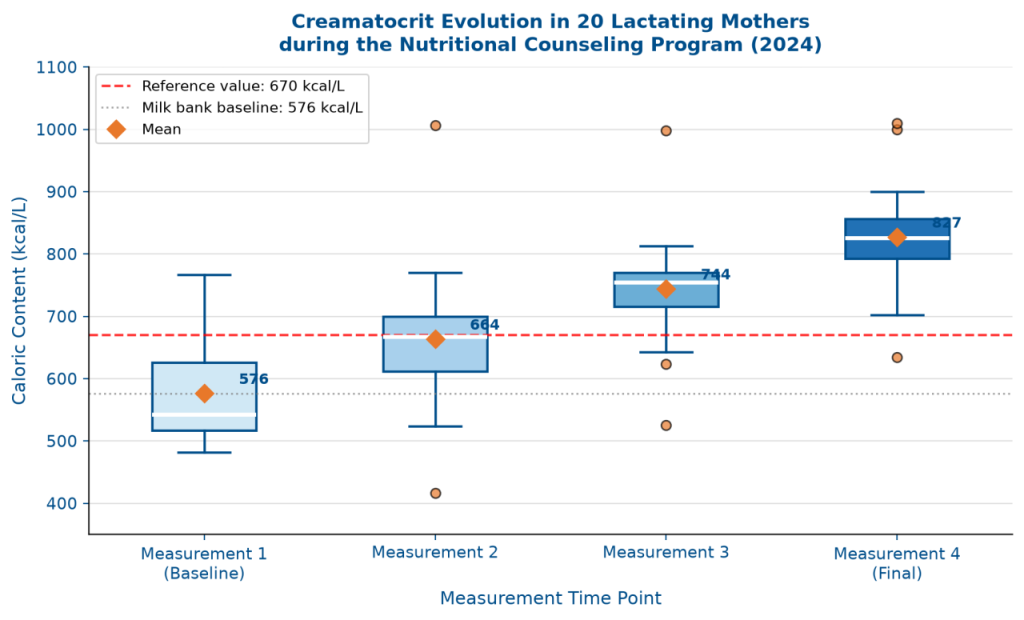
Figure 1: Distribution of creamatocrit (kcal/L) across the four serial measurements. The red dashed line indicates the 670 kcal/L reference value for mature human milk. Orange diamonds represent group means.
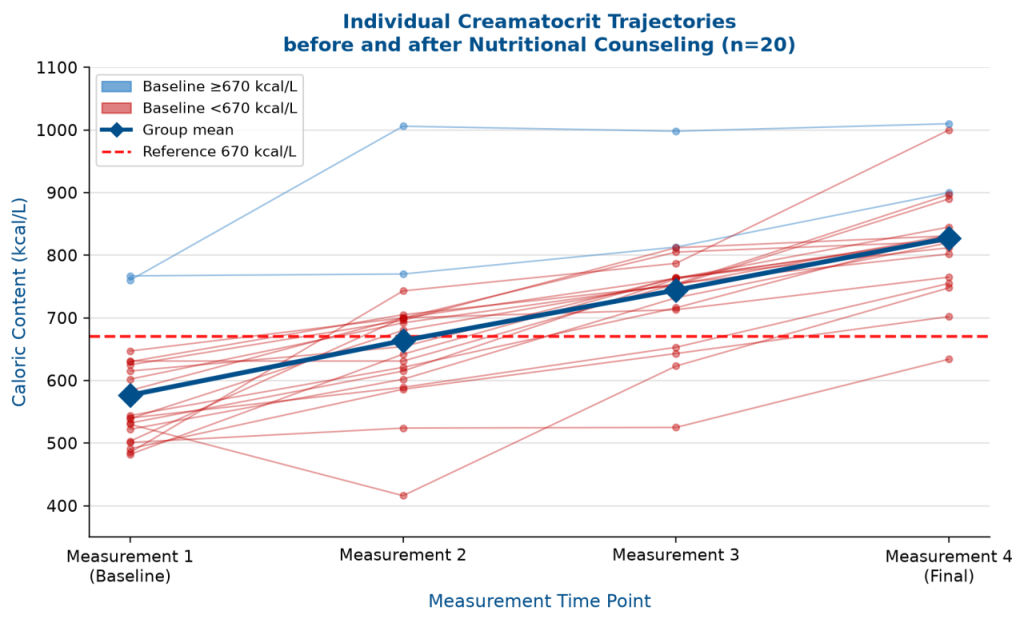
Figure 2: Individual creamatocrit trajectories before and after nutritional counseling (n = 20). Red lines: mothers with baseline creamatocrit < 670 kcal/L; blue lines: baseline >= 670 kcal/L. The thick blue line represents the group mean.
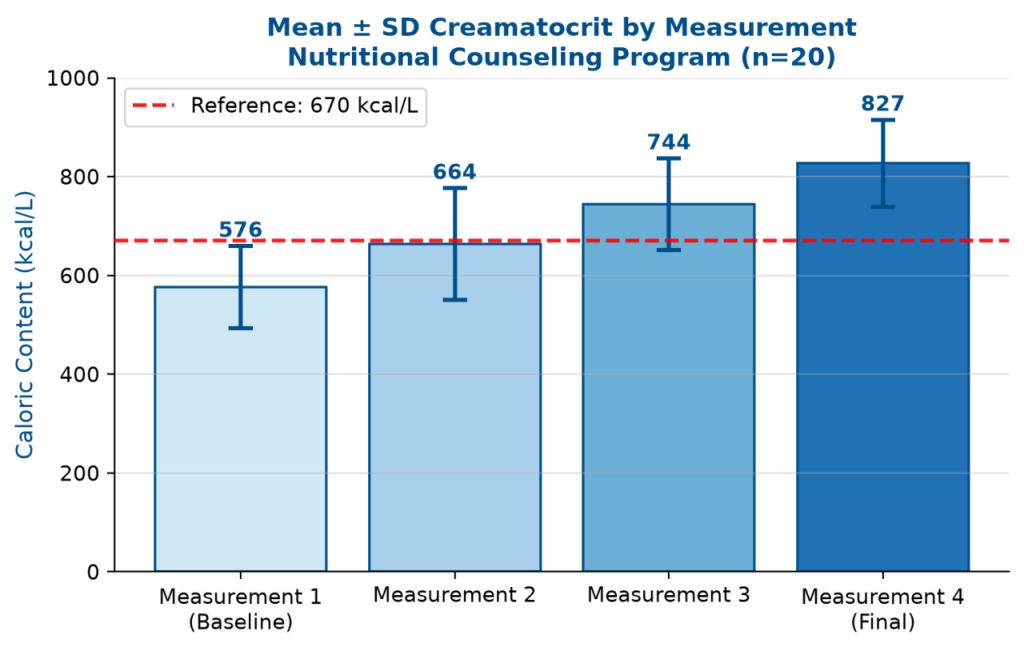
Figure 3: Mean +/- SD of creamatocrit by measurement time point. All follow-up measurements exceeded the 670 kcal/L reference from measurement 3 onward.
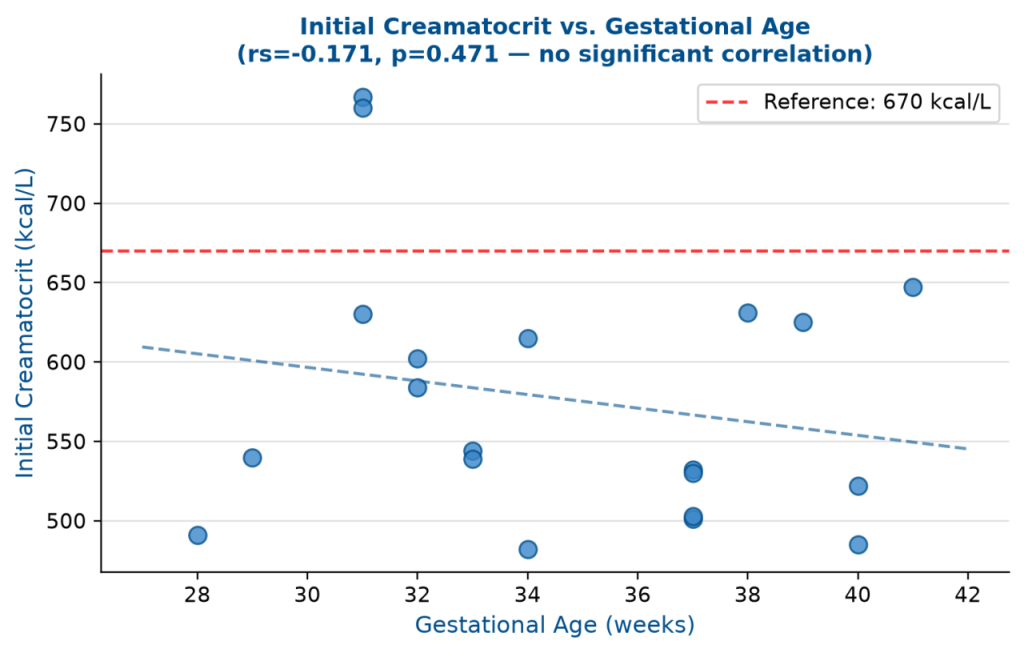
Figure 4: Initial creamatocrit by gestational age (rs = -0.171, p = 0.47). No statistically significant correlation was observed.
The mean creamatocrit value recorded in our milk bank (576 +/- 38.999 kcal/L) is lower than the 670 kcal/L reference standard described for mature human milk. This finding is not isolated: similar studies conducted at milk banks in Brazil and Europe report comparable values in donated frozen milk, noting that the freeze-thaw process alters the fat globule membrane, promoting lipase activity and, consequently, reducing the fat content measurable by creamatocrit (8). In our setting, Mexican regulations mandate the acceptance only of donated frozen milk with less than 15 days post-expression, making this phenomenon nearly universal across the hospital milk bank.
A finding that deserves special attention is the independence of creamatocrit from gestational age. Contrary to the clinical intuition — which might assume higher fat content in the milk of mothers of premature newborns due to the effect of early preterm milk — caloric values were similar between mothers at 28 weeks and mothers at 40 weeks’ gestation. Vazquez-Roman et al. (2014) reported analogous results in their analysis of donated frozen milk in Spain, suggesting that individual maternal factors — rather than the newborn’s gestational age — determine the lipid composition of milk (9). This has direct practical implications: assignment of milk by caloric content in the bank cannot be based on the donor’s gestational age, but requires individual measurement of each sample.
The longitudinal component of the study provides evidence of particular clinical value: individualized nutritional counseling increased creamatocrit by an average of 43.5% (from 576.5 to 827.4 kcal/L, p < 0.001). This result is consistent with published evidence linking maternal nutrition with milk quality (3,6). Studies such as those by Koletzko et al. (2019) and Geddes et al. (2021) emphasize that adequate energy intake and essential fatty acids during lactation directly impact the fat concentration in milk (4, 6). Our experience adds local evidence to these observations, demonstrating that a structured program can achieve clinically significant improvements within weeks.
Several limitations of the study should be noted. The cross-sectional component did not include individual data for the 200 bank samples (only aggregate monthly statistics), which precludes a more robust multivariable regression analysis. The longitudinal component, while showing compelling results, has a small sample size (n = 20) and lacks a control group, so the influence of external factors — such as the natural progression of lactogenesis over time — cannot be ruled out. Studies with larger participant numbers and a randomized design would strengthen these conclusions.
Notable among individual cases is patient 18 (Flores Cardenas, 27 years, 40 weeks), whose milk evolved from 485 kcal/L at baseline to 1,000 kcal/L at the end of follow-up (+106.2% increase). Similarly, patient 4 (Pelcastre Tellez, 32 years, 34 weeks) progressed from 482 to 823 kcal/L (+70.7%), illustrating the potential of nutritional intervention in mothers with low baseline values.
Donated human milk at the Human Milk Bank of Hospital General Dr. Jose Maria Rodriguez showed a mean caloric content of 576 +/- 38.999 kcal/L during the May-August 2024 period, below the 670 kcal/L reference value for mature milk. This finding is consistent with reports from national and international milk banks and may be explained by the effect of the freezing process on milk fat.
Creamatocrit was found to be independent of the donors’ gestational age, underscoring the need to measure caloric content individually in each sample in order to appropriately guide milk allocation to newborns based on their specific requirements.
The individualized nutritional counseling program significantly increased the caloric content of milk in participating mothers (+43.5%, p < 0.001), reaching mean values of 827.4 kcal/L at the end of follow-up. The integration of maternal nutritional interventions into milk bank services represents a promising strategy for improving the quality of donated milk and thereby enhancing the nutritional prognosis of the premature newborn.
Creamatocrit is confirmed as an economical, reliable, and reproducible method for caloric classification of milk in Mexican milk banks, and should be incorporated routinely into neonatal clinical practice.
To all the staff of the Dr. Jose Maria Rodriguez General Hospital, particularly the milk bank staff: Itzel Monserrat Girón Gonzalez, Thania Urbina Alcalá, Alejandra Jiménez, and Ivonne Mireles.
- World Health Organization. Breastfeeding. Geneva: WHO. Available at: https://www.who.int/westernpacific/health-topics/breastfeeding
- Brockway MM, Daniel AI, Reyes SM, et al. (2024)., Human Milk Macronutrients and Child Growth and Body Composition in the First Two Years: A Systematic Review. Adv Nutr., 15(1):100149. DOI:10.1016/j.advnut.2023.100149
- Olson CM.(1994)., Promoting positive nutritional practices during pregnancy and lactation. Am J Clin Nutr.,59(2 Suppl):525S-530S. DOI:10.1093/ajcn/59.2.525S
- Geddes DT, Gridneva Z, Perrella SL, et al. (2021)., 25 Years of Research in Human Lactation: From Discovery to Translation. Nutrients.,13(9):3071. DOI:10.3390/nu13093071
- Fossli M, Ohman EA, Andal M, et al. (2025)., Nutrient Intake Among Lactating Women With Overweight and Obesity in Norway. J Hum Nutr Diet., 38(1):e70000. DOI:10.1111/jhn.70000
- Koletzko B, Godfrey KM, Poston L, et al.; (2019)., EarlyNutrition Project Systematic Review Group. Nutrition During Pregnancy, Lactation and Early Childhood and its Implications for Maternal and Long-Term Child Health: The Early Nutrition Project Recommendations. Ann Nutr Metab., 74(2):93-106. DOI:10.1159/000496471
- Gila-Diaz A, Witte Castro A, Herranz Carrillo G, et al. (2021)., Assessment of Adherence to the Healthy Food Pyramid in Pregnant and Lactating Women. Nutrients.,13(7):2372. DOI:10.3390/nu13072372
- Tanriverdi S, Koroglu O, Uygur O, et al. (2021)., Evaluation of macronutrient content of fresh and frozen human milk over 6 months. J Matern Fetal Neonatal Med.,34(12):1875-1882. DOI:10.1080/14767058.2019.1651269
- Vazquez-Roman S, Alonso-Diaz C, Garcia-Lara NR, Escuder-Vieco D, Pallas-Alonso CR. (2014)., Creamatocrit measurement of caloric content of donated frozen breast milk. An Pediatr (Barc).,81(3):185-188. DOI:10.1016/j.anpedi.2013.08.021
- Lucas A, Gibbs JA, Lyster RL, Baum JD. (1978)., Creamatocrit: simple clinical technique for estimating fat concentration and energy value of human milk. Br Med J., 1(6119):1018-1020. DOI:10.1136/bmj.1.6119.1018