
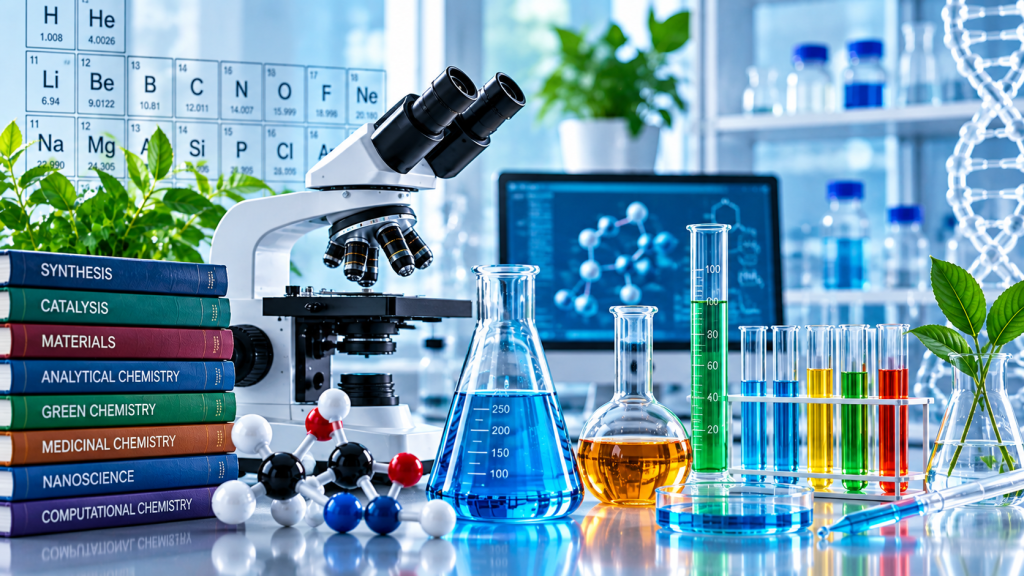
Journal of Advances in Chemistry and Research (JACR) is an international, peer-reviewed journal dedicated to publishing high-quality research and scholarly contributions across the broad field of chemistry and related interdisciplinary disciplines.
The journal provides a platform for researchers, academics, scientists, educators, and industry professionals to communicate advances in fundamental and applied chemistry, emerging chemical technologies, innovative methodologies, materials, computational approaches, and practical applications.
JACR welcomes original research, review articles, mini-reviews, short communications, perspectives, and other scholarly contributions covering traditional and emerging areas of chemical science.
The journal particularly encourages innovative research at the interfaces of chemistry with materials science, nanotechnology, biology, medicine, environmental science, physics, engineering, energy, and computational sciences.
The Journal of Advances in Chemistry and Research (JACR) aims to advance the understanding and application of chemical sciences by providing an international platform for the dissemination of innovative, rigorous, and impactful research.
The journal seeks to promote:
- Fundamental advances in chemical science
- Development of new chemical methodologies
- Innovative materials and chemical technologies
- Sustainable and environmentally responsible chemistry
- Computational and data-driven chemical research
- Chemical applications in medicine, energy, environment, and industry
- Interdisciplinary collaboration across scientific and technological fields
- Emerging research directions in chemistry
The Journal of Advances in Chemistry and Research (JACR) covers fundamental, applied, interdisciplinary, and emerging areas of chemistry. The journal welcomes research contributions across the following areas:
Analytical methods and techniques
Chromatography and separation science
Mass spectrometry
Nuclear magnetic resonance spectroscopy
Infrared and Raman spectroscopy
UV-Visible and fluorescence spectroscopy
Electroanalytical methods
Chemical sensors and biosensors
Chemometrics and analytical data analysis
Organic synthesis and reaction methodology
Heterocyclic chemistry
Natural products and bioactive compounds
Coordination chemistry
Transition-metal chemistry
Main-group chemistry
Organometallic chemistry
Bioinorganic chemistry
Molecular and supramolecular systems
Chemical thermodynamics
Chemical kinetics and reaction dynamics
Quantum chemistry
Molecular spectroscopy
Statistical and theoretical chemistry
Molecular modeling and simulation
Density functional theory and quantum calculations
Computational reaction studies
Cheminformatics and molecular informatics
Advanced functional materials
Nanomaterials and nanostructures
Polymer synthesis and characterization
Polymer nanocomposites
Carbon-based materials
Two-dimensional materials
Metal-organic frameworks and porous materials
Smart and stimuli-responsive materials
Surface and interface chemistry
Medicinal chemistry
Drug discovery and molecular design
Pharmaceutical chemistry
Pharmaceutical analysis
Bioactive molecules
Drug delivery and formulation chemistry
Protein and peptide chemistry
Enzyme and biomolecular chemistry
Chemical biology and molecular interactions
Environmental analytical chemistry
Water and wastewater chemistry
Air and atmospheric chemistry
Soil and environmental chemistry
Pollutants and emerging contaminants
Green synthesis and green solvents
Sustainable chemical processes
Waste valorization and resource recovery
Carbon capture and sustainable chemistry
Electrochemical processes and reactions
Electrocatalysis
Batteries and energy storage
Supercapacitors
Fuel cells and hydrogen technologies
Photocatalysis and photoelectrochemistry
Homogeneous and heterogeneous catalysis
Nanocatalysis and catalytic materials
Renewable energy and chemical energy conversion
Industrial chemistry and chemical processes
Process chemistry and chemical technology
Corrosion and materials protection
Coatings, adhesives and specialty chemicals
Food chemistry and food analysis
Food additives and contaminants
Agricultural and soil chemistry
Pesticide and agrochemical chemistry
Chemical quality control and safety
Artificial intelligence and machine learning in chemistry
Data-driven chemical research
Nanotechnology and chemical nanoscience
Chemistry–biology interfaces
Chemistry–medicine interfaces
Chemistry–physics interfaces
Chemistry–engineering interfaces
Chemistry for energy and sustainability
Emerging technologies and innovative chemical applications
The Journal of Advances in Chemistry and Research (JACR) is intended for researchers, academics, scientists, educators, students, and professionals working across chemistry and related scientific and technological disciplines.
Analytical Chemists
Organic Chemists
Inorganic and Organometallic Chemists
Physical and Theoretical Chemists
Computational Chemists
Materials Chemists
Polymer and Macromolecular Scientists
Food and Agricultural Chemists
Chemical Engineers
Medicinal and Pharmaceutical Chemists
Biochemists and Chemical Biologists
Environmental and Green Chemistry Researchers
Electrochemists and Catalysis Researchers
Nanochemistry and Nanotechnology Researchers
Energy and Sustainability Researchers
Industrial and Process Chemists
Materials Scientists
Pharmaceutical Scientists
Research Scientists and Laboratory Professionals
Academic Researchers and Faculty
Postdoctoral Researchers
Graduate Students and Research Scholars
Industry R&D Professionals
Chemistry Educators and Science Professionals
Why Publish With Us?
We are committed to empowering researchers by providing a transparent, efficient and high-quality publishing experience.
International Peer-Reviewed Journal
High-quality manuscripts are reviewed by experts from around the world.
Immediate Open Access Publication
Your research is published online immediately after acceptance.
Rigorous Editorial and Peer Review
Each submission undergoes a thorough and unbiased peer review process.
Rapid Editorial Decision
We ensure a swift and efficient review process for timely editorial decisions.
DOI Assigned to Every Published Article
A unique DOI is assigned to every article for permanent identification.
Crossref DOI Registration
All DOIs are registered with Crossref for global citation and linking.